

Written by the Fitmanpro production team. We manufacture custom BJJ kimonos and rashguards for academies and fight teams in over twelve countries. Every IBJJF rule cited below is verified against the current IBJJF Rule Book before publication.
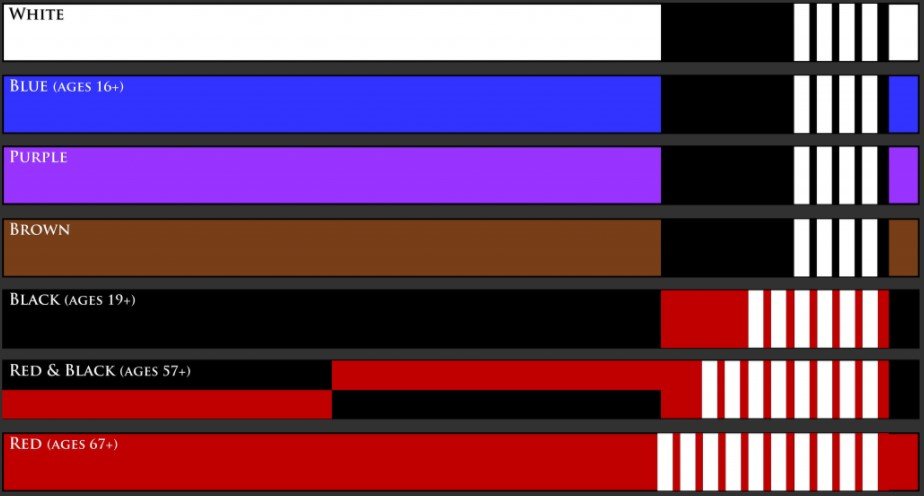
The BJJ belt order for adults runs white, blue, purple, brown, black, coral (red and black), coral (red and white), and red. Each colored belt holds four stripes before promotion. The IBJJF Graduation System defines the official progression, time-in-grade, and ranking criteria followed by academies worldwide.
This guide walks you through every adult and kids belt, what each rank means, how long it takes, and the IBJJF rules that govern promotion. We have also added a manufacturer’s section on gi standards and patch placement, drawn from years of producing custom kimonos for academies across the USA, UK, UAE, and Europe.
Table of Contents
Quick Answer — BJJ Belts in Order at a Glance
The adult Brazilian Jiu-Jitsu belt order, as defined by the IBJJF, follows eight ranks:
- White Belt
- Blue Belt
- Purple Belt
- Brown Belt
- Black Belt (with 6 degrees)
- Coral Belt — Red and Black (7th degree)
- Coral Belt — Red and White (8th degree)
- Red Belt (9th and 10th degree)
Promotion between colored belts requires both a minimum time-in-grade and a level of technical, behavioral, and competitive merit determined by your professor. Time alone never promotes a student. Kids follow a separate 13-belt progression to bridge the gap before joining the adult system at age sixteen.
The Official IBJJF Adult Belt Order Explained
Before any belt is awarded, two conditions must be met. The practitioner must have trained the IBJJF minimum time at the previous rank. The professor must have judged the student technically and behaviorally ready. The eight adult ranks are detailed below.
White Belt — The Starting Rank
Every adult BJJ journey starts at white belt. There is no IBJJF minimum time required before promotion, and progression is judged entirely by your professor.
At white belt, the focus is survival, posture, base, and the foundational positions — closed guard, mount, side control, back control. Most students train at white belt for one to two years before earning blue.
In the gis we produce for partner academies, we frequently see new white belts request lighter pearl weave (350–375 GSM) kimonos to ease the break-in period and stay cool through their first year.
Blue Belt — Establishing Your Game
Blue belt marks the first major rank in adult BJJ. The IBJJF requires a minimum of two years at blue belt before promotion to purple.
This is where most students start to identify their game — guard player or passer, top or bottom, gi or no-gi. Submissions become more reliable. Defense begins to outpace offense.
Per IBJJF Graduation System Article 3, blue belt cannot be awarded to anyone under sixteen years of age.
Purple Belt — Refining Technique
Purple belt is widely considered the most technically transformative rank in BJJ. The IBJJF minimum time at purple before brown is one and a half years.
By purple, your game becomes intentional. You set up submissions in chains, recognize patterns mid-roll, and start teaching white and blue belts during open mat.
Brown Belt — Approaching Mastery
Brown is the shortest colored belt for most practitioners. The IBJJF minimum is one year at brown before black.
The work shifts from learning new techniques to refining existing ones, sharpening transitions, and developing instructor-level understanding of position and timing.
Black Belt — Expert Practitioner
Black belt is not the end. It is the start of mastery. The IBJJF awards six degrees within black belt over the following decades.
Minimum time-in-grade per degree, per IBJJF:
- 1st to 2nd degree: 3 years
- 2nd to 3rd degree: 3 years
- 3rd to 4th degree: 5 years
- 4th to 5th degree: 5 years
- 5th to 6th degree: 5 years
Reaching 6th degree black belt requires at least twenty-one years past first-degree promotion. Few practitioners get there before their mid-fifties.
Coral Belt — Red and Black (7th Degree)
After seven years at 6th degree black belt, a practitioner is eligible for the coral belt — red and black. The name “coral” comes from the Brazilian coral snake, whose colors the belt mirrors.
This rank is rare and carries enormous respect. The IBJJF requires verifiable lineage and continued contribution to the art.
Coral Belt — Red and White (8th Degree)
After another seven years, the 7th degree coral can be promoted to the 8th degree — the red and white coral belt.
At this stage, the rank reflects contribution to BJJ as a whole more than active competition.
Red Belt — Grand Master (9th & 10th Degree)
The red belt is the highest rank in Brazilian Jiu-Jitsu. The IBJJF awards 9th degree after ten years at 8th degree.
10th degree red belts are reserved for the founding Gracie brothers — the originators of Brazilian Jiu-Jitsu — and the rank is no longer awarded.
How BJJ Belt Promotion Works — Stripes & Time-in-Grade
Between colored belts, the IBJJF system uses stripes. Each adult colored belt (white, blue, purple, brown) holds four stripes before promotion to the next rank.
Stripes are awarded at the professor’s discretion based on:
- Time on the mat
- Technical progression
- Tournament results (weighted in many academies)
- Behavior and contribution to the academy
There is no official IBJJF time requirement between stripes. Most academies use six-month intervals as a rough guide, but a high-frequency competitor can earn stripes faster.
Black belt uses degrees, not stripes. Each degree is marked by a black bar on the red section of the belt.
Kids’ BJJ Belt Order (Ages 4–15)
The kids’ BJJ belt system uses thirteen belts to recognize progress more frequently. This bridges the long gap between starting BJJ as a child and earning an adult blue belt at sixteen.
The 13-Belt Kids Progression
In IBJJF order:
- White
- Grey and white
- Grey
- Grey and black
- Yellow and white
- Yellow
- Yellow and black
- Orange and white
- Orange
- Orange and black
- Green and white
- Green
- Green and black
Each belt holds four stripes before promotion. Children may begin earning the grey belt from age four.
Transitioning From Kids to Adult Belts
At age sixteen, kids’ belts are converted to the adult system. A green-and-black four-stripe student typically receives blue belt at sixteen — though final decision rests with the professor.
Students under sixteen cannot wear an adult blue belt, regardless of skill, per IBJJF Article 3.
How Long Does Each BJJ Belt Take?
These are the IBJJF minimum times. Your academy may require more, and most students take longer than the minimums.
| Belt Transition | IBJJF Minimum | Realistic Average |
|---|---|---|
| White → Blue | No official minimum | 1–2 years |
| Blue → Purple | 2 years | 2–4 years |
| Purple → Brown | 1.5 years | 2–3 years |
| Brown → Black | 1 year | 1–2 years |
| Total (white → black) | ~4.5 years minimum | 8–12 years average |
Source: IBJJF Graduation System
In practice, BJJ black belt takes most people a decade. Injuries, life events, training frequency, and academy culture all affect the timeline.
BJJ Belt Order vs Karate vs Judo — Key Differences
If you have trained other martial arts, the BJJ belt system can feel slow. That is by design.
- Karate: Typically ten colored belts, with black belt achievable in 3–5 years
- Judo: Six colored belts, with black belt achievable in 3–5 years for most practitioners
- BJJ: Five colored belts, with black belt averaging ten years
BJJ’s relatively few belts and longer time-in-grade reflect its emphasis on live sparring as the test of progression. There are no kata. There is only rolling, refereed competition, and your professor’s judgment.
Read our full comparison — BJJ vs Wrestling for MMA & Self-Defense
Gi & Patch Requirements at Each Belt
This section draws on years of manufacturing custom kimonos for academies worldwide. The IBJJF has strict rules on gi construction, patch placement, and color — and many students lose competition matches before they step on the mat, simply because their gi fails the official check.
IBJJF Gi Rules for Competition
The IBJJF mandates the following for gi construction:
- Cotton or similar fabric, with weave thick enough to resist easy gripping
- Sleeve must reach the wrist with the arm extended forward
- Pant leg must reach the ankle
- Lapel thickness of 1.3 cm and width of 5 cm at the chest
- Approved colors: white, royal blue, or black (single solid color, no two-tone gis)
A non-compliant gi at IBJJF events results in a check-in failure and bracket disqualification. From the orders we ship for competition prep, sleeve length is the single most common compliance fix requested — followed by lapel thickness.
We build every Custom BJJ Gi order to IBJJF specification on request, with academy logo and rank patches positioned to the federation’s tolerances.
For events outside the IBJJF — local academy tournaments, gi-optional events — gi standards relax substantially.
Where Rank Patches Go on Your Gi
The IBJJF allows patches in the following zones:
- Front of jacket — both lapels, chest area
- Back of jacket — center back and shoulders
- Sleeves — outer side
- Pants — outer thigh and bottom of pant leg
Patches must not cover seams. Total patch area is limited, and the IBJJF inspects randomly at major events. Use our IBJJF Gi Checker Tool to verify patch placement before you compete.
Choosing Gi Weight (350–550 GSM) by Belt Level
In our experience producing gis for BJJ academies and fight teams worldwide, gi weight tends to track with rank:
- White and blue belts: 350–400 GSM pearl weave — lightweight, breathable, easier to break in
- Purple and brown belts: 425–475 GSM — durable enough for high training volume, still light
- Black belts and competitors: 500–550 GSM gold weave or heavyweight pearl — competition-grade durability
This pattern is observed, not prescribed. A black belt rolling no-gi six days a week may prefer their lightest 350 GSM gi. A blue belt at a strength-focused academy may want a heavier gi from day one.
Frequently Asked Questions
How many belts are in BJJ?
There are five adult colored belts — white, blue, purple, brown, and black — plus the coral (red and black, red and white) and red belts awarded at advanced black belt degrees. Kids follow a separate thirteen-belt system.
How long does it take to get a BJJ black belt?
The IBJJF minimum is approximately four and a half years after blue belt, but most practitioners take eight to twelve years. The average BJJ black belt has trained for around a decade.
Can a child have a BJJ blue belt?
No. Per IBJJF Article 3, adult belts (blue and above) cannot be awarded to anyone under sixteen. Kids progress through a separate thirteen-belt system instead.
What does a coral belt mean in BJJ?
The coral belt is the 7th degree black belt (red and black) or 8th degree black belt (red and white). It is named after the Brazilian coral snake and is a rare, highly respected rank.
Do stripes matter in BJJ?
Yes. Each adult colored belt holds four stripes before promotion to the next rank. Stripes are awarded by the professor based on time, technique, behavior, and competition — there is no fixed IBJJF time between stripes.
What is the highest belt in BJJ?
The red belt is the highest rank, awarded at 9th and 10th degree. The 10th degree was reserved for the founding Gracie brothers and is no longer awarded.
Ready for Your Next Belt? Custom Gear That Matches Your Rank
Whether you are a white belt buying your first kimono or a brown belt outfitting your academy, the gi you wear should match the rank you have earned. We manufacture custom BJJ gis, ranked rashguards, and full academy kits to IBJJF specification — from twelve pieces per design, with a free design service on every order.
Use our IBJJF Gi Checker Toolto verify your gi meets federation standards, or request a free quote for your next academy order.